

Engagement Matters: To support, please subscribe and share the post + hitting the ‘’ heart button on this post. Any/all engagement helps creators tremendously!
Twice As Good Hair: https://twiceasgoodhair.com/
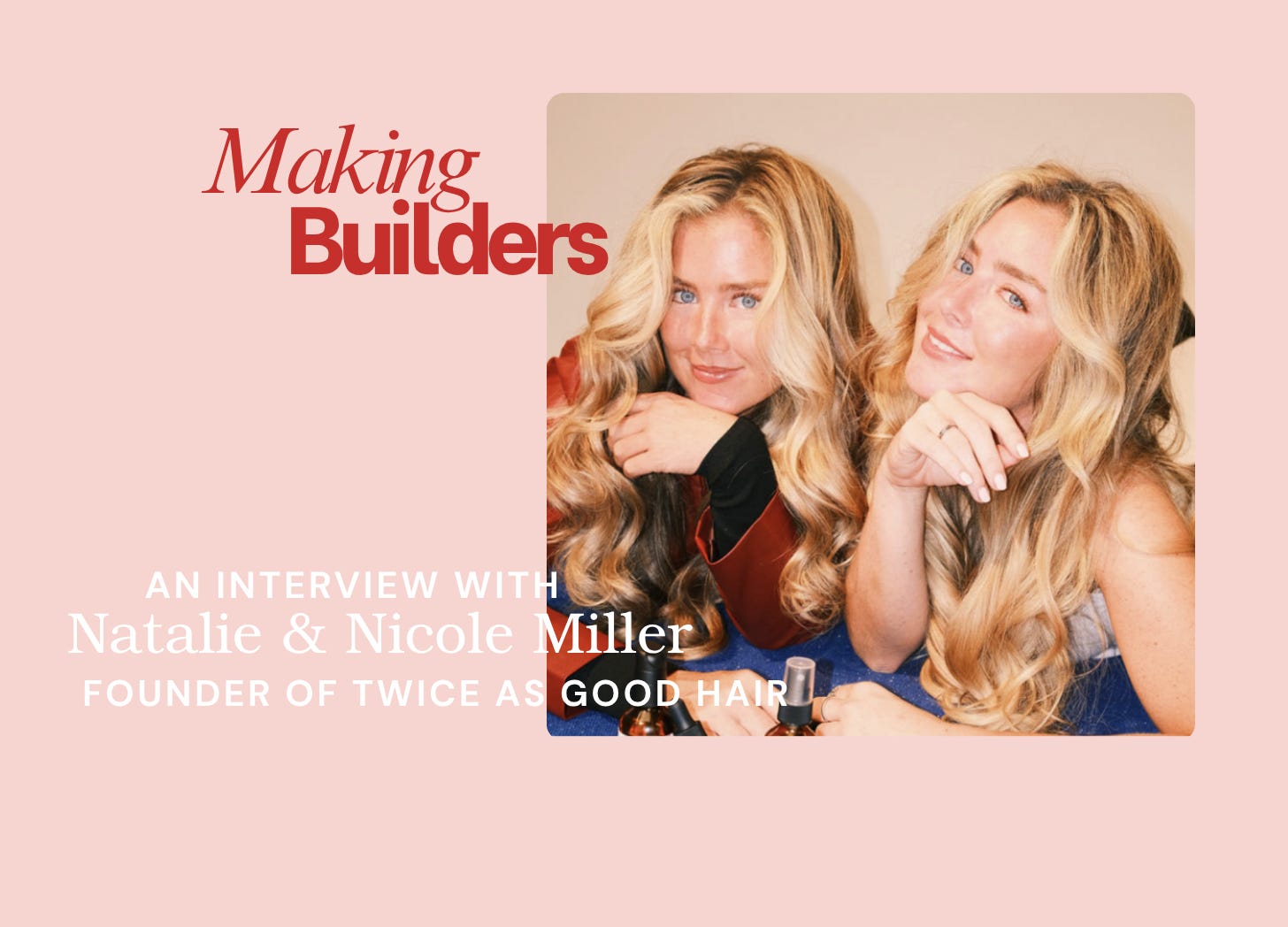
Take us back to the moment you and Natalie realized this wasn’t just a personal hair journey, it was something other women needed too.
I feel like most amazing solutions are born out of personal problems. It was a huge problem for both of us, but more so for Natalie. She went to a hairstylist and completely fried off her hair, then went through the whole trajectory: Olaplex, K18, extensions, the whole nine — trying everything to repair it because she was so insecure.
We’re twins, so you’re constantly getting compared, and nothing was working. It really hit us that there wasn’t anything out there besides the pipeline to extensions, which are incredibly expensive, high maintenance, and inaccessible to so many people. And even then, they come with their own issues — the weight, the tracks showing, washing your hair and feeling like you’re carrying 20 pounds on your head.
Through all of that, Natalie went back to basics. Across cultures : Black, Indian, Asian, hair oiling has always been a thing. But in Caucasian culture, everything is synthetic and artificially based. She started pulling from those traditions, experimenting, and realized some oils were too heavy, some protein-based solutions were too harsh for bleached hair.
Eventually, she found a formulation using lighter-weight oils that actually repaired her hair. She shared the journey on social media, and it went off like wildfire. The comments were flooded with “this is me,” “this is my story,” “how did you do it?” That’s when it stopped being just about us. It became clear this was an entire demographic of women who’d dyed their hair since middle school and were still paying the consequences.
Twice As Good Hair emphasizes organic, research-backed ingredients at effective concentrations — not trends. What was non-negotiable for you when it came to formulation?
Hydration and high-quality, deeply hydrating ingredients were the non-negotiable.
Almost every hair product on the market is protein-based. You can check your own products: Ulta, Target, Walmart, they’re all protein-heavy. For fragile, damaged strands, protein overload is incredibly common and leads directly to breakage. So we were obsessive about sourcing the highest standard of hydrating ingredients and avoiding what actually causes long-term damage.
You worked with chemists, stylists, and trichologists early on. What surprised you most once science entered the conversation?
Everyone came at it from their own bubble. Stylists, chemists, trichologists they all had different answers based on their background.
What shocked us was realizing how stylists are trained. Many go to schools sponsored by big brands like Paul Mitchell or Aveda, and they’re taught how to cut and color, not how to maintain hair health. Product usage is often commission-based, not quality-based.
Stylists were honest with us. They told us, “They never taught us this.” So we had to bridge the gap between what stylists see on the front lines and what science actually supports. We worked with scientists many formerly from big beauty brands, who were genuinely passionate about clean, organic solutions, not just slapping something on a label.
That combination changed everything. It wasn’t about proving a claim. It was about changing an industry that hasn’t evolved in decades.
The brand grew alongside Natalie’s TikTok journey — without paid ads. Why do you think your story resonated so deeply on that platform?
Because it’s not a “maybe.” It’s what will happen.
Ask anyone who’s bleached their hair. Most will say it never recovered. They’ll say bleach ruined their hair, or now they rely on extensions. Before indie brands and social media, we trusted big players without questioning them.
Now people research. They read ingredients. They listen to lived experience. When we shared our story and the results spoke for themselves, people connected deeply. They thought they had to chop their hair off or give up bleach forever and suddenly there was another option.
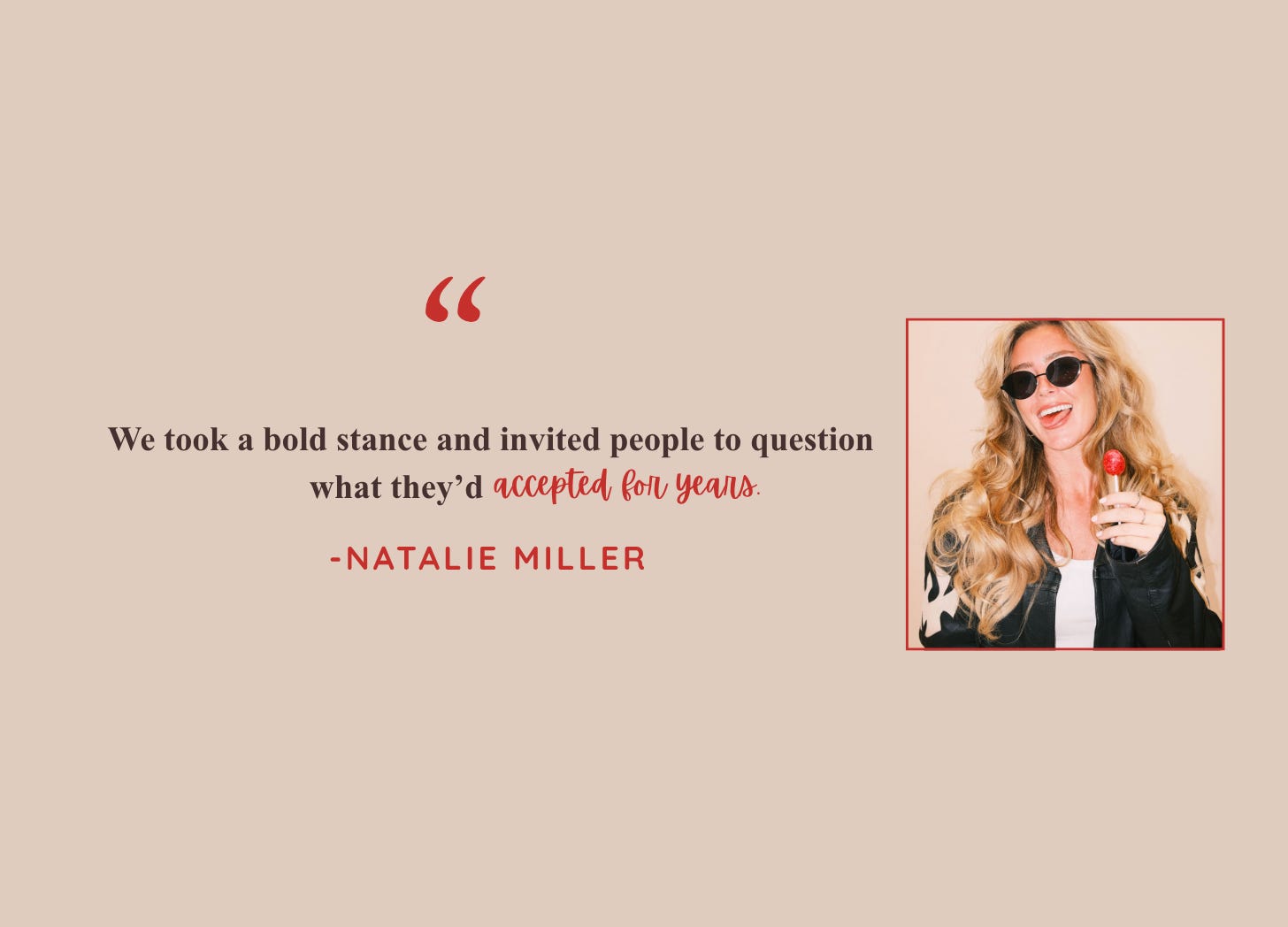
We took a bold stance and invited people to question what they’d accepted for years.
What’s something people misunderstand about building a product-led brand through social media?
It’s actually the most honest era to build a brand.
Before, you bought big-name products without ever knowing who made them. Now, you see the heartbeat and soul behind what you’re using. You can’t bullshit customers anymore.
People get to know the founder their values, their morals, their why. That intimacy builds trust. I’ve lived the problem myself. I know exactly what our customers are going through. It feels like we’re best friends solving the same issue together.
Social media gives instant feedback, authenticity, and a massive advantage over soulless corporations.
How do you balance education, vulnerability, and credibility when showing up online?
By being the proof.
I use these products daily. This isn’t posing with a bottle and a discount code. I show my routine, my wash days, my oiling — real life. Social media becomes a mirror of what actually works.
Education plus lived experience creates credibility.
You both walked away from stable corporate tech careers to go all in. What fear showed up the loudest right before you made that decision?
We come from a middle-class corporate family. No entrepreneurs. So when we said we were leaving stable tech jobs, our family looked at us like we had three heads.
But tech gave us something valuable: the ability to bootstrap. We funded everything ourselves while working two jobs for almost two years. No investors. No debt.
The bigger fear wasn’t financial it was living a soulless life. Every day felt like “living the dream,” sarcastically. We knew we had more to offer than collecting a paycheck.
What did corporate life prepare you for — and what did it absolutely not prepare you for?
Corporate taught us structure, discipline, and how to execute. It did not prepare us for purpose.
It felt bland. Empty. Like a corpse of a life before you’re even old. Building something with heart, soul, and meaning felt like the only option — even with uncertainty.
How do you think hair, identity, and self-trust are connected, especially for women?
Hair is everything.
A huge percentage of women’s confidence comes from their hair and men too. Look at how many people travel for hair transplants.
A small haircut can change how someone shows up entirely. Our products aren’t one-time fixes — they become part of your life, your routine. When you invest in yourself that way, everything shifts: confidence, self-respect, presence.
It’s a small step that creates a massive impact.
You’ve now shipped to every U.S. state and beyond fully bootstrapped. What part of this growth are you most proud of?
That we built this our way, with obsession, purpose, and integrity.
We want the best products, the best service, the best mission. We’re not chasing competitors. We’re in our own lane, solving hair growth and repair with intention.
It’s sister-led. Twin-led. Fun. Authentic. And built entirely on our own terms.
If you zoom all the way out from kitchen experiments to a nationwide brand, what has never changed about why you’re building this?
We want to be a real solution. Accessible. Honest. And deeply human.
This is us, behind the scenes, in front of the camera, inside the bottle and outside of it. No covering our mouths. No pretending. Just showing up as we are.
If a woman is at the very beginning of her own journey, hair, business, or self, what do you hope she feels when she discovers Twice As Good Hair?
Relief.
Like finally laying down at night and thinking, “This works.” After wasting money, time, and confidence finding a solution that brings it back.
We hear it every day in DMs and voice notes. We’re a safe haven. A place where something finally clicks.
And that feeling? That’s everything.
https://twiceasgoodhair.com/